![]()
Egyptology is the study of ancient Egyptian history, language, religion, and art. Become an Egyptologist! Learn about the periods and dynasties in Egypt's history with the interactive timeline. Read about how the ancient Egyptians lived in the factsheets.
![]()


The Rosicrucian Egyptian Museum has many examples of cat images from ancient Egypt, in every material form bronze, through wood, and including mummies!
Cats were first domesticated in ancient Egypt. This means that all cats were wild until the Egyptians began sharing their homes with them. This happened over 6,000 years ago! All of our cats today are descended form Egyptian wild cats.
Egyptians loved their cats, and considered them to be protectors of the house. Most cats did not have names: they were just called Ta-Mieuw, or "The Meower", out of respect for their privacy. The Egyptians thought a name was magical. Cats were so spoiled in Egypt, that some even wore jewelry, such as earrings.
After death, the housecat was mummified and given a decent burial. One prince of Egypt, Thutmose, had his little female cat, "Ta-Miewet", buried with him in a stone coffin of her own.
The cat lived well in Egypt, even when the state religion changed to Christianity, and later, Islam. There is a legend that the Prophet Mohammed so loved cats, that he cut the sleeve off his own coat, rather than wake a kitten that had fallen asleep on it, Another legend says that Egyptian cats are striped, because those are the finger marks where the Prophet petted their ancestors. Even today, cats are treated better in Egypt than in many other parts of the Near and Middle East. But if you travel and decide to take home a kitten, make sure it is a tame one and not one of the wild cat cousins of the desert!


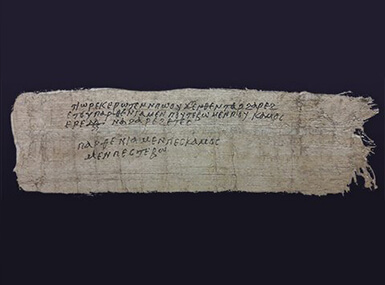
Very few people in ancient Egypt could read or write, perhaps as few as 2%. The people who could were called scribes, pronounced “sesh” in the language of ancient Egypt. Scribes learned the skill of writing in the schools of Egypt, which were called “Houses of Life”, or “Per Ankh”. Only boys attended these schools, as far as we know, though a few women were said to be scribes, and we know that some could read and write. It was a very difficult skill to learn, as the Egyptians had more than 500 hieroglyphic signs in their written language.
The first sort of writing he learned was the kind called today “hieratic”. This was the handwritten version of hieroglyphs, and used for everyday things, like writing letters to family friends or keeping store records. This eventually became “demotic”, which is almost like shorthand. Those students who mastered this kind of writing were allowed to learn hieroglyphs - used for sacred and royal work in the temples and in the palace.

Scribes wrote on many different types of materials. One of these was papyrus. Papyrus was like paper, but it was very expensive. If a scribe was taking notes for a letter, he would often write on a broken piece of pottery or stone to save the valuable papyrus, and then transfer the information neatly to papyrus for “mailing”. Statues and temples had hieroglyphs carved into the stone, since those were sacred and royal documents.
After the Macedonian rulers called the Ptolemies took over control of Egypt in 332 BC, more and more of the Egyptian language was written with Greek letters. By about 1600 years ago, no one was learning to read hieroglyphs, or even hieratic and demotic, so no one could read any of the scrolls or temple walls or statues any more. For 1600 years, all people could do was make up stories based on the little animals that hieroglyphs showed. Egypt became a great mystery.
How did we eventually learn to decipher the Egyptian language? Read about Rosetta to find out!
Rosetta was not a person; it was the name of a village in ancient Egypt! And a stone that was discovered there by accident, was the key that allowed modern researchers to understand ancient Egyptian writing!
Napoleon arrived in Egypt in 1798. One of his soldiers found a chunk of rock near the town of Rosetta by accident. This rock came to be known as the Rosetta Stone. This stone had been erected in 196 BCE to commemorate the ninth year of the reign of the pharoah Ptolemy V (Epiphanes). The stone described some of the honors that Egypt's temple bestowed upon the king. It also listed all of the benefits that Ptolemy brought to his people.

This stone became very famous because it helped us to decipher the Egyptian written language that had long been out of use. The Rosetta stone had an inscription written three times: once in hieroglyphic (the script used for royal and sacred purposes), once in demotic (the native script used for daily purposes), and once in Greek (the language of the administration). People could still read Greek, and it appeared that these 3 inscriptions said the same thing. The British won the war against Napoleon, and claimed the Rosetta Stone as a settlement in the peace treaty. The French made copies before they sent it to England, and the race was on to see who would decipher Egyptian first.
The prize went to a most unlikely person: a young man named Jean Francois Champollion. At a very young age, he showed that he had a gift for languages and studied Hebrew, Syriac, Ethiopian, and Arabic. Then moved on to Persian, Sanskrit, and most importantly, Coptic, the spoken language of ancient Egypt, still used in the Egyptian Coptic Church. At only 17 years old, he began presenting scientific papers, and he began to work on the Rosetta Stone when he was 18 years old. When he was 32 years old, he proved he had broken the code. Hieroglyphs were not a picture language, in which an image of a bird means “bird”, but an alphabetic language, in which the signs stand for sounds, just like we use today in English, but with a lot more signs.

This is how Jean Francois figured this out. He looked at the cartouches, these rings you see here. He thought there must be a reason that the characters were encircled; he decided that it must be the name of the king at the time, Ptolemy, which was written at the same intervals in the Greek text. As he worked through the royal names, he began to realize some of the words he was reading was Coptic. More and more of the words became clear, and finally, he told the world the secret: hieroglyphs were the written form of the Coptic language, and it was written alphabetically, and so could be sounded out.
This opened the door for other Egyptologists to begin their work, and today, we know almost every sign and can read any document from ancient Egypt.
Do you want to find out how a body was mummified? Read on!
This is the mummy that came to us in Usermontu’s case; he is a real Egyptian mummy.
- First the body would have been brought to a place called the “IBU” meaning “tent of purification” where the body is washed.
- Then a series of magical spells were cast to purify his soul or 'Ka'.
- The body would have then been transferred to what is called the PER NEFER or Good House, where it would have been turned over to a High Priest known as the “Controller of Mysteries”. He was a representative of the Jackal headed God, Anubis—the god of embalming. The controller of Mysteries would use the personnel under his authority to carry out the actual mummification process.
- The first step would have been to remove the water in the body. Did you know that the human body is made up of approximately 75% water? If a body is to be preserved, the moisture has to be removed. Otherwise bacteria will grow and this will lead to decay.
- The mummification priests would have begun by inserting a metal rod through the nostrils to scramble, liquefy and remove the brain! The Egyptians thought that the brain did not serve any purpose in the afterlife.
- The mummifiers would then make an incision on the left-hand side of the abdomen. They removed the stomach, lungs, liver and intestines. The heart remained inside the chest, as it does today in this gentleman. The body now had a large hole in the abdominal region.
- The organs, and the hole in the abdominal region would have been washed with palm wine for disinfection.
- Then the organs, and the body would have been covered with a material called “Natron” and left to dry for 40 days. Natron is of the same chemical composition as salt and baking soda. It’s extremely absorbent and would have helped to remove the water from the organs and the body.
- At the end of the 40 day drying period, the internal organs were removed from the natron, cleaned, wrapped in linen, and placed inside what are called canopic jars.
- The outside of the body would also be cleaned. The mummifiers would then anoint the skin with perfumes and oils, to try to make the skin a little more flexible. Then they would spend 15 days or so wrapping the body very tightly in linen. The purpose of the wrappings on a mummy is to help the body maintain its shape. As they were wrapping, they included amulets, which they believed would help protect the body and soul in the underworld.
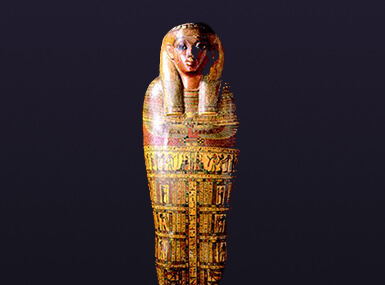
- Once the body is completely wrapped, it was placed inside a wooden coffin. The coffin and body would be taken to the tomb by the family.
- At this point, the body was ready for burial, and the spirit of the person was ready to begin its journey to the Afterlife.
![]()