Latest News: Full Story
|
![]() |
| Curator Lisa Schwappach carefully moves the lid of the coffin of Ta'awa. |
Over the last several months, incredible changes have been taking place at the Rosicrucian Egyptian Museum, in Gallery A, the “Mummy Gallery,” a perennial favorite of visitors from around the world. The total renovation and re-arrangement of our displays concerning the Afterlife were motivated by both educational and preservation concerns.
As Lisa Schwappach-Shirriff, the Museum’s Curator, puts it, “People respect what they see respected. By updating the Afterlife gallery and making it safe for the artifacts based on the latest scientific standards of conservation, we demonstrate that we value these living connections to our history which have been entrusted to us. The new display methods have already helped the Rosicrucian Egyptian Museum greatly enhance the respect accorded our collection in both the scientific community and among the general public.
“Already this year, both the National Geographic and Discovery Channels have filmed in our museum, during August and early September. We have one of the best collections of Egyptian artifacts in the world, and the only one west of the Mississippi that is fully available to the general public, rather than only to scientific researchers.”
Ms. Schwappach-Shirriff is justly proud of the renovations and restorations in the Afterlife gallery. This process has been painstaking, professional, and thorough. Last year, the Rosicrucian Order, which owns and operates the Museum, obtained a grant to study the display and preservation of the artifacts. Ms Tamsen Fuller, the independent conservator who contracted to conduct the study, found that the display cases were out-gassing and acidic. Both of these phenomena would, over extended time, damage the artifacts. The study recommended sealing the wood and the rubber wallpaper in the cases, in order to separate the acidic materials from the artifacts.
![]() |
| Museum staff Farima Berenji, William Barnett and Curator Lisa Schwappach install a coffin in a temporary case during renovations. |
After the case interiors were designed, an additional idea evolved. The Museum’s Cleopatra VII statue had recently returned from a world tour that included the Field Museum of Chicago. At the Field, the newly renovated galleries are painted in a “faux rock” design, to give the impression of entering an underground tomb. Why couldn’t the museum do the same, replicating a “faux limestone” with paint and texture, surrounding the cases which would contain the afterlife artifacts, and adjacent to the venerable and ever-popular rock tomb replica. In consultation with the Museum Director, Curator Schwappach-Shirriff designed this aspect as well, to complete the schematics for the renovation.
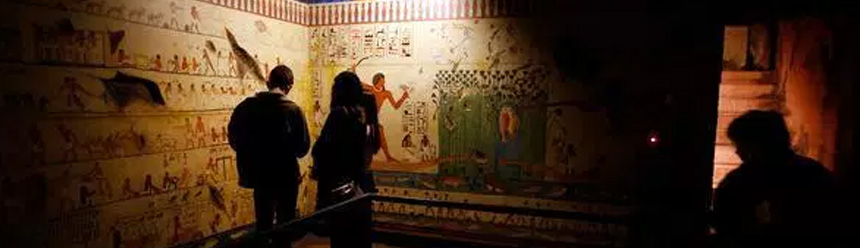
All of this was planned to better protect and preserve the artifacts. But educational values also determined the vision for the new gallery. The mummies, coffins and grave goods would be chronologically arranged, so that visitors could have a consistent and informative journey through the evolution of Egyptian afterlife and funerary practices, before entering the tomb tour in our Beni Hasan replica educational experience.
Now the stage was set. Plans were made, materials purchased, and schedules set. And it was none too soon. Exterior work was badly needed. The adhesives on the aged wallpaper were failing, which would require removal of the wallpaper and repainting.
![]() |
| Tour Guide Max Sanchez Paints Gallery A Cases with primer. |
A professional artifact moving company was contracted to assist Museum employees in moving the heavy artifacts, coffins and mummies. On one Monday in late May, all of the treasures were moved from Gallery A to safe locations in the other galleries, or in the Museum’s vault.
With the removal of the artifacts from the gallery, the museum was afforded the opportunity to re-install the entire gallery. Now the gallery was ready, but who was going to accomplish all of this renovation?
With the spirit of Park Founder H. Spencer Lewis, the new Museum Building’s founder Ralph Lewis and other Rosicrucian luminaries as an inspiration, all renovation on the new Afterlife gallery has been entirely created “in house.” Curator Schwappach-Shirriff cross-trained the Museum staff, and volunteer members from the Administration staff, in all the steps necessary to do what needed to be done. Hidden talents and professional abilities emerged among the work crews in carpentry, painting and other skills.
Tireless construction, painting and work by the Curator and her faithful workers, week after week, has crafted a new home for the mummies and their grave goods. In early August, the mummies, coffins and grave goods made their return to their new home! Final touches, labeling and the creation of the educational guides to the gallery were completed in mid-August, and the new Exhibit had its grand VIP opening on the night of Saturday September 7.
The new gallery traces the development of afterlife practices from the Early Dynastic Period through the Ptolemaic Period of Pharaonic Egypt, a span of over three thousand years. The gallery is arranged chronologically, to show the development and evolution of funerary practices throughout these periods. Coffins and Mummies from various periods are displayed together with typical grave goods from the same period, so that the visitor experiences the artifacts together as they were originally created.
The artifacts have been researched thoroughly, so that the new labels with modern graphics and the returnable gallery walk guides which are available at the entrance to the gallery have the benefit of the latest scholarship in Egyptology and Archaeology.
This renovation marks the beginning of similar work in all of the Museum’s Galleries. Watch for more announcements on this web site!
Admission to The Egyptian Afterlife is included with admission to the museum.
See what benefits our members receive.